Towns
The game world is populated by residents who live in various towns which are spread across the map. Residents have a home where they live, a job where they work and a place where they go shopping.

Town Levels & Growth

Each town has a level, starting from Small Hamlet and ending with the Large Metropolis:
- Level 1: Small Hamlet
- Level 2: Hamlet
- Level 3: Large Hamlet
- Level 4: Small Village
- Level 5: Village
- Level 6: Large Village
- Level 7: Small Town
- Level 8: Town
- Level 9: Large Town
- Level 10: Small Suburb
- Level 11: Suburb
- Level 12: Large Suburb
- Level 13: Small City
- Level 14: City
- Level 15: Large City
- Level 16: Small Metropolis
- Level 17: Metropolis
- Level 18: Large Metropolis
The top section of the town window displays both the current level and the number of residents. The progress bar below shows the progress to the next level as well as an indication whether the town is currently growing or stagnating. It can be expanded to get a detailed breakdown of the current growth situation.
Town growth progresses gradually as it earns experience. A town needs 1,000 total XP to reach level 2. The XP required for each following level-up is 1.5 times the amount required for the previous level-up. Reaching a new level triggers a celebration.
Town growth is enabled by earning experience (XP). Raw XP is awarded when passengers or cargo reach their final destination in a town and then applied based on multiple conditions.
Explanation
The town's XP gain is:
Final XP = raw XP x XP multiplier
Passenger arrivals award XP according to where the passenger started the journey:
- 5 XP if the passenger came from the same town.
- 10 XP if the passenger came from a neighboring town.
- 20 XP if the passenger came from a town farther away.
Cargo deliveries award XP for each delivered item. The amount depends on cargo complexity:
- 10 XP for the least complex cargo types.
- 20 XP for the next complexity level.
- 40 XP for the most complex cargo types.
The XP multiplier depends on the town's Authority and Supplies ratings described below.
The player's headquarters provides an additional bonus to the growth multiplier. It starts at 5% and increases as the headquarters is expanded.
Towns grow by means of new or larger buildings, if the utilization is high and the land value as well as accessibility is good. Providing public transportation and supplying commercial and industrial buildings with cargo will also further an expansion. New buildings are constructed and existing ones are expanded. They also build new roads or upgrade existing ones to make room for additional buildings. The districts may grow at different rates, depending on their supply ratings.
Town Ratings
Town ratings summarize how well a town is served and the conditions its residents experience. The authority and supplies ratings affect how quickly a town earns growth experience.
Supplies Rating
The Supplies rating is the average of the passenger supplies rating and cargo supplies rating.
- Passenger supplies rating is based on how many people in the town use public transport. A line usage of 50% gives the maximum rating.
- Cargo supplies rating is the highest rating among districts with cargo demands. Each district's rating reflects how well its cargo demands are being met.
Towns start with one cargo demand in each of the commercial and industrial districts. They can gain up to two additional demands in each district as they reach higher levels:
- At the start: one demand in each district.
- Level 5: add a second commercial demand.
- Level 7: add a second industrial demand.
- Level 9: add a third commercial demand, which may be one of the most complex cargo types.
- Level 11: add a third industrial demand, which may be one of the most complex cargo types.
All buildings in a district share that district's cargo demands, though commercial and industrial districts demand different cargo types. More complex cargo types are required in smaller quantities per year.
The Supplies tab offers an overview of the current supply situation. The top section shows a breakdown of the supplies rating and a chart showing the development in the recent years.The section Statistics below shows a list of all possible passenger destinations and a list of all possible suppliers for the cargo demand and the numbers of the actual transportation within the last 365 days. When switched to the cargo list, the suppliers are also linked in the gameworld. An actively used link is animated, potential but unused links are static.
Town Authority Rating
 The Town Authority rating is determined by the lowest of six ratings. Improving the weakest rating has the greatest effect on the overall authority rating:
- Reputation reflects how the town and surrounding nature are treated. Landscaping, removing town buildings and breaking main connections to other towns can lower it, while celebrations and marketing campaigns can improve it. Reputation lost by removing trees can be recovered by planting new ones.
- Happiness reflects how well people's travel needs are met, including waiting times at stations and time spent travelling. The current situation is shown in the passenger satisfaction layer and details are provided when clicking on individual residents.
- Delivery measures whether cargo reaches its destination on time. While delayed cargo still provides the full income, the on time delivery rating drops, hindering town growth. Use the cargo satisfaction layer to identify the places where cargo goes past the limit.
- Traffic measures how smoothly road traffic flows. Reducing the number of congested streets improves this rating. The traffic layer gives orientation to identify the bottlenecks in the road network.
- Noise reflects noise levels in residential areas. The break down as well as the noise layer help identifying the hotspots.
- Pollution reflects pollution levels across the town area. The break down as well as the pollution layer help identifying the hotspots.
Several of the ratings are calculated based on effects within the town boundaries. They are shown when the town window or one of the relevant layers is opened.
Town Districts
 For each of the three needs of residents, there is a specialized district in every town. To highlight buildings with corresponding zone color, use the land use data layer.
The residential district is the place where the inhabitants live. In the land use data layer, its buildings are colored green. This district does not have a cargo need, but the residents tend to not use public transport when there is no passenger stop or station nearby. This district is sensitive to noise, thus it should be minimized in areas around residential districts.
The blue commercial district provides locations where inhabitants can go shopping and spend their free time. Buildings in this district all require cargo. This district is robust against the influence of noise.
Jobs for residents are located in the industrial district of each town. The buildings are colored yellow while using the land use data layer. Like the commercial district, this district is not influenced by noise in a negative way either. Cargo is also required by the buildings in this district.
Building Details

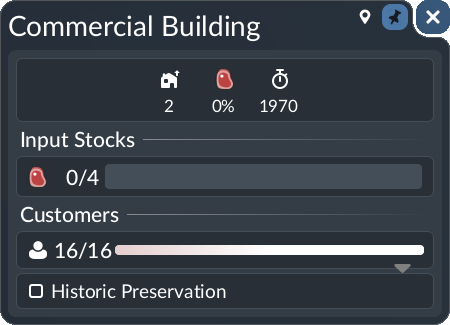
By selecting any town building in the gameworld, a window with some information appears. Depending on the type of building, it shows different information.
Residential buildings provide living space for the people in the game world. The number of maximum residents in one building depends on the building size and level. The detail window shows the total number of residents in this building as well as a detailed list of them with their current happiness and action. The window also displays the current noise level at the building. The historic preservation allows keeping a building in its current visual appearance.
Commercial buildings provide shopping facilities for the people in the game world. The number of maximum shopping facilities in one building depends on the building size. They also have cargo needs. The detail window shows the number of facilities that are available in total as well as the number of customers currently using them. Furthermore there is some information about the cargo type that is demanded and the current supply of this need.
Industrial buildings provide jobs for the people in the game world. The number of maximum jobs in one building depends on the building size. They also have cargo needs. The detail window shows the number of workplaces provided by this building and the number of workers as well as the supply rate for the cargo.
The supply rating indicates for a commercial or industrial building the percentage of the cargo needs currently fulfilled. A high supply rate increases the chance a building will level up.